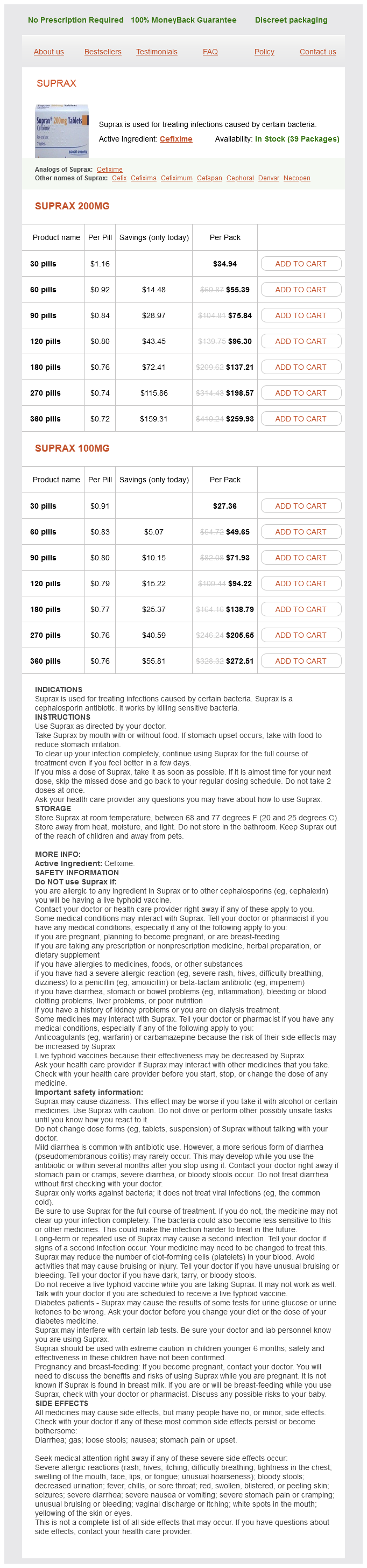
Suprax 200mg
Suprax 100mg
Suprax dosages: 200 mg, 100 mg
Suprax packs: 30 pills, 60 pills, 90 pills, 120 pills, 180 pills, 270 pills, 360 pills
In stock: 645
Only $0.8 per item
In contrast bacterial transformation generic suprax 100 mg buy on line, patients with muscular dystrophy show greater levels of voluntary activation and less central fatigue than expected. Muscle Disorders In muscle disorders, a variety of factors may contribute to fatigue, including increased recruitment and firing rate of motor units due to a reduced number of muscle fibers, altered skeletal stability and mechanical advantage, muscle pain, cardiorespiratory responses to increased effort, abnormal muscle metabolism, and altered afferent input from affected muscle. Excessive fatigue can be expected to be a particular feature of metabolic muscle disease (myophosphorylase deficiency, mitochondrial myopathies, and thyroid disorders) as opposed to the fixed weakness that dominates the clinical picture in dystrophies and inflammatory myopathy due to loss of muscle contractile elements. There is an important genetic contribution, but in most cases the exact pattern of a genetic inheritance remains unknown. Most affected people have febrile seizures that persist longer than the typical age and are followed by a variety of types of epilepsy. Severe prolonged febrile seizures in the first year of life are followed by severe epilepsy and associated encephalopathy. Complex febrile seizures and neurological dysfunction are not consistent predictors of recurrence. However, among those whose febrile seizures recur, children who initially present with a prolonged first febrile seizure are likely to experience additional prolonged seizures. This increase in risk between the simple and complex groups is statistically robust but in clinical practice should not often lead to changes in medical management. The association of prolonged febrile seizures and later intractable temporal lobe epilepsy is more complicated than simple cause and effect because there may be abnormalities in the temporal lobe, such as an area of malformation, that predate the febrile status (dual pathology). Most febrile seizures last only a few minutes and end before the child presents to the health care system. Identification of the source of fever is the next management issue, with meningitis to be excluded clinically or by lumbar puncture. Because many parents think their child is dying during the seizure, direct discussion of this fear is prudent. Routine blood work, brain imaging studies, and electroencephalography have no proven value. For any infant between 6 and 12 months of age who presents with a seizure and fever, a lumbar puncture is an option when the child is considered deficient in Haemophilus influenzae type b (Hib) or Streptococcus pneumoniae immunizations, or when immunization status cannot be determined, or because of an increased risk of bacterial meningitis. This common practice has not been subjected to a placebo-controlled randomized clinical trial. In both studies clobazam was started at the onset of fever and continued for 48 h. The other was a small prospective, randomized, double-blind placebo-controlled trial. Side effects appeared minimal but the studies were small and further confirmatory trials are needed. Generally, the side effects of daily medication or intermittent benzodiazepines (given during fevers only) to prevent recurrent febrile seizures outweigh the minimal benefit of their use. Antipyretics may render a febrile child more comfortable, but this is their only role in the treatment of febrile seizures.
Diospyros kaki (Japanese Persimmon). Suprax.
Source: http://www.rxlist.com/script/main/art.asp?articlekey=97060
Cervical cord stimulation virus quarantine 100 mg suprax order overnight delivery, peripheral nerve section, and surgery that cuts the nerve roots (rhizotomy) or involved muscles (myotomy) are occasionally effective, but these procedures do not address the central nervous system abnormalities that underlie the muscle spasms and also have permanent implications. Stacy M and Jankovic J (1995) Rare movement disorders associated with metabolic and neurodegenerative diseases. A disruption of this link, as occurs in the muscular dystrophies, causes membrane instability and may result in muscle necrosis. Dystrophin has four domains: the Nterminus, which contains the actin-binding site, a long central rod region with 24 spectrin-like repeats, a cysteine-rich domain, and the C-terminus. The cysteine-rich domain and C-terminus contain binding sites for b-dystroglycan and syntrophin. Dystrophin is absent in Duchenne muscular dystrophy and its expression is decreased in Becker muscular dystrophy. Adapted with permission from Ehmsen J, Poon E, and Davies K (2002) the dystrohin-associated protein complex. In addition to this structural role, signaling functions regulating blood flow to the exercising muscle have been associated with the complex. Dystrophin is present in skeletal, smooth, and cardiac muscles as well as in nonmuscle tissues including the brain. An increasing number of muscular dystrophies have been linked with the deficiency of dystrophin or one of its associated proteins. It is expressed in the skeletal, heart, and vascular smooth muscle and is encoded by a gene on chromosome 8. Dystroglycans Dystroglycan provides a link between laminin in the extracellular matrix and dystrophin in the membrane cytoskeleton. It consists of two subunits (a and b), which are encoded by the same gene and produced by posttranslational cleavage of a precursor protein. Glycosylation of the a-dystroglycan (156 kDa) allows it to link to laminin and the glycosylation of b-dystroglycan (43 kDa) modulates its association with the intracellular cytoskeleton. Defective glycosylation causes a group of muscular dystrophies called dystroglycanopathies, which have a spectrum of clinical severity. Sarcospan Sarcospan is a 25 kDa transmembrane protein that closely associates with the sarcoglycan complex. No sarcospan gene mutations have been associated with muscular abnormalities in humans. Dystrobrevins a-Dystrobrevin (87 kDa) is a protein predominantly found in muscle and brain. No a-dystrobrevin mutations have been identified to date in muscular dystrophy patients. Sarcoglycans the sarcoglycan complex is composed of six transmembrane proteins, all expressed primarily in the skeletal muscle. A mutation affecting the expression of any one of the sarcoglycans affects the expression of the entire complex.
By late 1889 bacteria mitochondria suprax 100 mg order free shipping, Eijkman had begun using chickens for his studies, presumably because they were cheaper and easier to maintain than either rabbits or monkeys. Histological examination of peripheral nerves stained by the Marchi method showed axonal degeneration most pronounced in the legs, which resembled the changes observed in the peripheral nerves of people who died of beri-beri. Curiously, though, both injected and control chickens were affected and because they had been kept together in large cages, Eijkman suspected that the chickens he had injected with microorganisms had somehow spread the putative infection to the control chickens. However, in additional experiments he found that keeping the chickens in separate cages made no difference, causing him to wonder whether the entire institute had become infected. Then the cook was replaced and his successor refused to allow military rice to be taken for civilian chickens. Despite the negative results of his transmission experiments and the subsequent positive results of his dietary experiments, Eijkman had trouble abandoning his initial microbiological framework. Development of beri-beri also did not depend on whether the polished rice was cooked or raw, on the water used for cooking, or on the presence of coarse rice husks as a source of dietary fiber. Eijkman found that the polyneuritis could be cured or prevented by feeding the chickens either unpolished rice or the discarded rice polishings. However, birds fed on a combined diet of starch and meat ultimately developed beri-beri, even though they did not become emaciated. Rations were highly standardized in Java prisons, but the type of rice was not specified and therefore open to the discretion of the prison governors, local market availability, and prices. Vorderman sent a form letter to each prison governor asking for the incidence of beri-beri and the type of rice in use. By 1896, preliminary results suggested that beri-beri was almost exclusively confined to prisons using polished white rice. Vorderman spent the next 5 months visiting all 101 prisons scattered across the large island, taking samples of the rice used, recording the frequency of beri-beri over the previous 18 months, and recording environmental information about each prison. Vorderman found that of the 96 000 people imprisoned at institutions using unpolished rice, less than 1 in 10 000 (0. Although beri-beri prevalence varied dramatically with the type of rice used, it did not vary with the source of the rice (imported or locally produced), the age of the buildings, floor permeability, adequacy of ventilation, or degree of overcrowding. On the basis of these data, limited as they were, Vorderman persuaded governmental authorities to modify the prison diets to include more unpolished rice, and also more beans and other vegetables. The subsequent change in disease incidence was not formally studied, although it was reported that this public health measure rapidly eliminated beri-beri from the prison populations. Later Career In 1898, after his return to the Netherlands, Eijkman was appointed as professor of hygiene and forensic medicine in Utrecht. Here he resumed his study of bacteriology, and developed a test of whether water has been contaminated with coliform bacteria. He was also a vocal proponent of public health, and engaged himself in campaigns against alcoholism and tuberculosis, and in problems of water supply, housing, school hygiene, and physical education. Because the frequency of beri-beri varied across prisons, Eijkman and Vorderman considered the possibility that the See also: Funk, Casimir. Electrocorticogram Electrocorticography is the process of recording electrical activity in the brain by placing electrodes in direct contact with the cerebral cortex or surface of the brain.
Syndromes
Additional information:
Usage: t.i.d.
Tags: cheap 100 mg suprax, order 100 mg suprax fast delivery, safe suprax 100 mg, cheap suprax 200 mg without prescription
Yespas, 26 years: Taken together, these studies confirm a shift in balance between pain inhibition and facilitation with a net increase in facilitation. In November 1987, a large outbreak of poisoning with DomA occurred in the Canadian provinces of New Brunswick and Quebec. The intrinsic physiological property of integrating these components of the nervous system he termed action commune.
Lisk, 31 years: The most common abnormalities include generalized slow activity with occasional paroxysmal bursts. Dopamine binds to two major classes of G protein-coupled dopaminergic receptors on the postsynaptic nerve: D1-like and D2-like. Largely because of the celebrity and international power of Charcot, Gilles de la Tourette syndrome was named for this young colleague, although celebrated French physicians Jean Marc Gaspard Itard (1825) and Armand Trousseau (1873) had already offered excellent medical descriptions of tic disorders.


