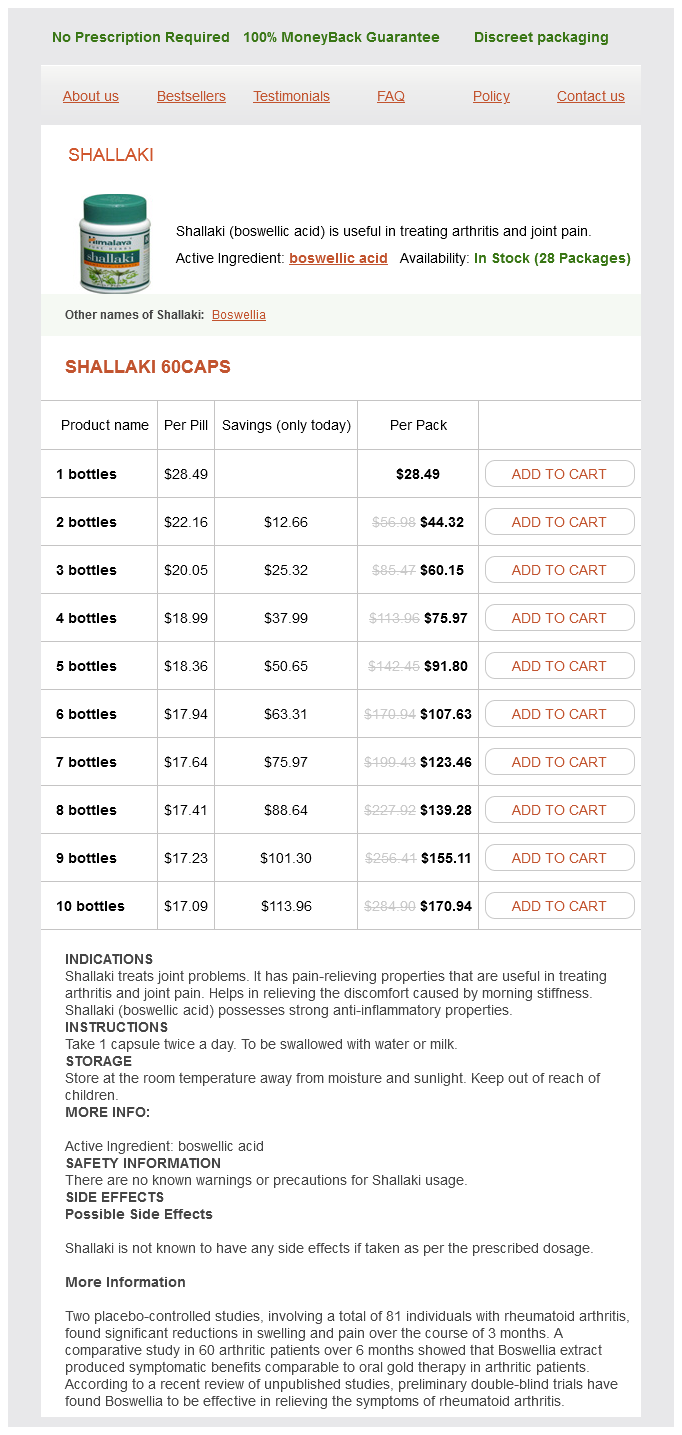
Shallaki 60caps
Shallaki dosages: 60 caps
Shallaki packs: 1 bottles, 2 bottles, 3 bottles, 4 bottles, 5 bottles, 6 bottles, 7 bottles, 8 bottles, 9 bottles, 10 bottles
In stock: 796
Only $18.16 per item
The presumed position of the debris within the labyrinth during the maneuver is shown in each panel muscle relaxant for back pain shallaki 60 caps without a prescription. The patient should be kept in the final, face-down position for about 10 to 15 sec. With the head kept turned toward the left shoulder, the patient is brought into the seated position, D. Once the patient is upright, the head is tilted so that the chin is pointed slightly downward. The membranous superior semicircular canal (seen in cross section) is in contact with the overlying contents of the middle cranial fossa. Compare this with the right side, where a very thin plate of bone is separating the superior semicircular canal from the middle cranial fossa. The patient was known to have neurofibromatosis type 2, and this lesion is most likely a schwannoma of the eighth cranial nerve. Vestibular migraine, which can be considered a migraine variant, affects women more often than men, particularly women in their childbearing years. As with migraine headache, it is a diagnosis of exclusion, since there are no pathognomonic tests for this condition. Diagnostic criteria consist of a combination of the International Headache Society criteria for migraine headache and criteria developed specifically for vestibular migraine. The pathophysiology is uncertain but is likely to be related to serotonin effects on central vestibular structures. Treatment is similar to the treatment for migraine headache and includes both decreasing triggers for migraine and use of pharmacotherapy. For patients with frequent (greater than one per week) episodes of vestibular migraine, prophylactic medications are indicated to reduce the frequency and severity of attacks and include antidepressants, -blockers, anticonvulsants, and calciumchannel blockers. Central vestibular structures in the brainstem and cerebellum are supplied by the posterior inferior cerebellar artery and the anterior inferior cerebellar artery. Infarction of the lateral medulla in the territory of the posterior inferior cerebellar artery leads to a Wallenberg syndrome, wherein one of two vestibular nuclear complexes is damaged, leading to central vestibular imbalance. Accompanying symptoms are caused by involvement of the ascending spinothalamic tract and descending sympathetic tracts. Another condition to be considered in patients with acute vertigo and accompanying neurologic disturbances referable to the brainstem and cerebellum is that of cerebellar hemorrhage or infarction with concomitant brainstem compression. Vertebrobasilar insufficiency may present with various neurologic symptoms including vertigo and changes in hearing as well as symptoms referable to posterior fossa structures, such as changes in vision, sensation, strength, or level of consciousness. Treatment with antiplatelet agents and management of risk factors for cardiovascular disease are warranted for most cases; endovascular treatment with angioplasty, stenting, or both, is rarely employed.
Trans-capsaicin (Capsicum). Shallaki.
Source: http://www.rxlist.com/script/main/art.asp?articlekey=96908
Unusual neurologic features are visual symptoms muscle relaxant powder shallaki 60 caps with amex, hallucinations, hemichorea, tonic eye deviation, nystagmus, abnormal pupils, and meningeal signs. The correction of hyperglycemia may be more effective than using antiepileptic agents to treat the seizures. Diabetic Polyneuropathy Diabetic polyneuropathy is the most common form of peripheral neuropathy. Symptomatic polyneuropathy may occur in a smaller proportion, estimated as approximately 15 percent of these patients. Polyneuropathy is most often sensory, or sensorimotor but with lesser motor involvement. Positive sensory symptoms are common and include prickling, tingling, "pins and needles," burning, crawling, itching, electric, sharp, jabbing, and tight sensations in the legs, feet, hands, and fingers. Warm stimuli may be inappropriately perceived as cold, and cold stimuli as warm or hot. Nocturnal burning of the feet accompanies allodynia (the generation of pain or discomfort from normally innocuous stimuli). Many of these symptoms are associated with pain, sometimes severe or intractable, as discussed later. Negative symptoms include loss of sensation to light touch, pinprick, and hot and cold. In more severe diabetic polyneuropathy, loss of protective sensation predisposes patients to the development of foot ulcers. Additional factors that promote foot ulceration include loss of sweating, abnormal foot architecture from muscle wasting, delayed healing, and both macrovascular (atherosclerosis) and microvascular disease. Motor involvement is less common in early diabetic polyneuropathy but may eventually lead to distal weakness of foot and toe dorsiflexion, predisposing patients to falls. Symptoms from concurrent abnormalities of the autonomic nervous system are common. A detailed neurologic examination provides a low-cost, patient-interactive means of direct evaluation. While some variation in findings, especially in patients with early disease, is expected, the examination remains the gold standard for Hypoglycemia Hypoglycemia most often presents with altered neurologic function. A high index of suspicion is required as patients may present with focal neurologic signs or seizures. Premoni-tory systemic symptoms include anxiety, tachycardia, perspiration, nausea, and tremor, but these signs may be absent in patients taking -adrenergic-blocking medications or in patients with autonomic neuropathy.
However gastric spasms cheap shallaki 60 caps online, position statements and clinical practice guidelines are updated regularly, highlight broadly used (and in some cases validated) instruments relevant to specific patient populations, and describe emerging techniques that can aid in diagnosis and treatment. Common and/or often under-recognized sequelae are listed and suggested as prompts. In general, examination maneuvers and related diagnostic studies or consultations parallel the domains queried in Table 37-1. When possible, measures documenting impairment or symptom severity should be tracked over time in order to gauge recovery trajectory or efficacy of treatment plans. Unexplained focal neurologic signs or symptoms consistent with alternative diagnoses should prompt neuroimaging to exclude a structural cause. New signs or symptoms emerging after the first 1 to 2 weeks should also lower the threshold for neuroimaging or other indicated diagnostic studies. Targeted cognitive screening may be appropriate early after injury, depending on the patient population, to ensure impairments are within typical domains and not indicative of another condition. However, referral for full neuropsychologic evaluation for common complaints may not be warranted until confounders such as pain and sleep impairment are addressed. Table 37-2 lists examples of potential diagnostic and therapeutic strategies for each domain listed in Table 37-1. For each category, ruling out red flags with urgent or emergent diagnostics is implied. Many professional organizations recommend that clinicians educate patients via verbal and written material when possible regarding diagnosis, recovery, and clinic or emergency room return precautions. The approach includes rapid identification and characterization of brain injury followed by targeted diagnostic and therapeutic programs that also involve patient education. In general, 1 to 2 days of rest is appropriate, including cognitive and physical rest with avoidance of overstimulation, followed by graded increases in usual activities with light to moderate intensity and with sufficient rest in between exposures provided the prescribed activities do not cause clinically significant symptoms. Symptom recrudescence may occur with increasing cognitive, physical, or even emotional challenges, and early expectation management and subsequent scaling of activity prescriptions may mitigate related distress, reluctance to engage in activity for fear of worsening injury, or any actual risk of injury exacerbation. It is important to note, however, protracted rest or abstinence from activities, if not clinically indicated, may lead to patient isolation and prolong symptom burden. One biologically plausible explanation in support of an exercise prescription relates to possible effects of aerobic exercise activity on cerebral blood flow. With careful counseling and safety screening, a patient may be able to conceptualize subthreshold aerobic exercise as a dose of medication even on days when prescribed physical activity has already occurred, or on days when the patient feels particularly unwell. This is an active area of investigation targeted to identify periods of maximal benefit (and potential harm), establish frequency and intensity of exercise, and to more clearly characterize physiologic, neurobehavioral, and quality of life improvements. Exercise in general has clearly demonstrated powerful health advantages across disciplines for numerous medical conditions.
Syndromes
Additional information:
Usage: q.h.
Tags: purchase shallaki 60 caps without a prescription, purchase shallaki 60 caps online, generic shallaki 60 caps with visa, order shallaki 60 caps line
Hatlod, 50 years: The presence or absence of neurologic complications dictates the optimal timing of surgery for both native and prosthetic valve endocarditis, as do cardiac function and the control of the infection. Streptokinase has been associated with the development of GuillainÀBarré syndrome. Kumral E, Polat F, Güllüoglu C, et al: Spinal ischaemic stroke: clinical and radiological findings and shortterm outcome. The classic bullseye rash may not be recalled by patients or may be missed in around 30 percent of patients.
Sven, 24 years: Both have an elevated risk of dementia, cerebral atrophy, and the presence of white matter abnormalities. Chronic changes likely reflect in part the effects of sustained hypertensive episodes and may present with cognitive decline featuring prominent executive dysfunction. Dexamethasone testing can be confounded by agents that alter steroid clearance, including some antiepileptic drugs. Clinical studies have detected specific genomic mutations present in brain metastases, but not in the primary tumor or in extracranial metastases.
Bradley, 28 years: Hypothermia is common in Wernicke Skin disorders Occlusive dressings Drugs encephalopathy and may be the presenting feature. Nevertheless, they will still need to be monitored closely for signs of progression that would prompt urgent intervention. In general however, hydroxyamphetamine testing has insufficient specificity to be clinically valuable to direct additional diagnostic evaluation once Horner syndrome is diagnosed. The drugs most commonly implicated are neuroleptics and antipsychotic medications with central dopamine-blocking actions, including phenothiazines.
Cruz, 43 years: However, in infants and children (80 to 90% of those infected before 1 year) as well as in some adults (approximately 5% of those infected), the acute infection is often asymptomatic but evolves into a chronic active hepatitis, with progression to cirrhosis and possibly hepatocellular cancer. Concentric needle electromyography of the pelvic floor is possible since motor units of the pelvic floor and sphincters fire tonically; they therefore may be captured conveniently using a trigger and delay line and subjected to individual motor unit analysis. The authors concluded that the risk of central pontine myelinolysis was greatest in patients with chronic hyponatremia, where a judicious correction strategy should be employed. Homozygosity for the thermolabile form is found in 5 to 15 percent of the general population who have significantly elevated plasma homocysteine levels.
Agenak, 39 years: More commonly, the nerve is compromised as it traverses the meninges and subarachnoid space, or facial paresis is due to intra-axial inflammation of the facial nerve motor nucleus. A dose of 5 to 20 mg of diazepam can be given intravenously every 5 to 10 minutes until the patient is lightly somnolent, followed by 5 to 20 mg every few hours as needed to control delirium and agitation, with a ceiling dose of about 60 mg of diazepam per day. The card agglutination trypanosomiasis test, which detects specific antibodies, is of value for screening of at-risk patients for T. For example, the unilateral optic nerve section does not produce anisocoria; the pupil will not exhibit a direct light reaction, but will react consensually to light stimulation of the opposite eye.
Steve, 33 years: Postural hypotension, from loss of sympathetic control of resistance arterioles, is defined as a decline of systolic pressure by 20 mmHg or more-or of diastolic pressure by at least 10 mmHg-after 1 minute of standing, with associated orthostatic dizziness or fainting; it occurs in 3 to 6 percent of diabetics and may be a late feature of diabetic autonomic neuropathy. Careful studies have also brought to light previously under-recognized syndromes of otologic syphilis, characterized by early sensorineural hearing loss and occasionally by vestibular dysfunction as well; and of ocular syphilis, mostly an early posterior uveitis affecting the choroid, retina, and pigmentary retinal epithelium. As a group, the aminoglycosides cause degeneration of the sensory hair cells of the cochlea, the outer hair cells being most severely affected, accounting for the preferential loss of higher frequencies, whereas gentamycin selectively destroys the vestibular hair cells. Patients present with macrothrombocytopenia, mild splenomegaly, increased serum vitamin B12, and markedly decreased or absent platelet -granules.
Lars, 58 years: There is no optimal duration of subsequent systemic therapy, and it should usually be continued until 2 cycles beyond the best response, progression of disease, or unacceptable toxicities. Focal intracranial mass lesions and subarachnoid hemorrhage also need to be included in the differential diagnosis when approaching patients with suspected meningitis. Other adjunctive methods such as the reattachment of intercostal arteries, the use of shunts to maintain distal perfusion pressure, and the use of cerebrospinal fluid drainage have not proved consistently effective at preventing spinal cord ischemia, although the more recent experience with such adjunctive techniques has been quite favorable. Neonatal tetanus results from contamination of the umbilical cord, and in some areas the mortality rate is a high (but uncertain and geographically variable) proportion of all births.
Ismael, 36 years: Malignant or atypical nerve sheath tumors may follow irradiation of the brachial, cervical, or lumbar plexuses. Patients are often left with profound morbidity even when the progression of disease is halted. Episodes typically last only seconds, but may recur numerous times throughout the day. This rash can be differentiated from the rash of a viremia in that petechiae are found on the trunk and lower extremities in meningococcemia.


