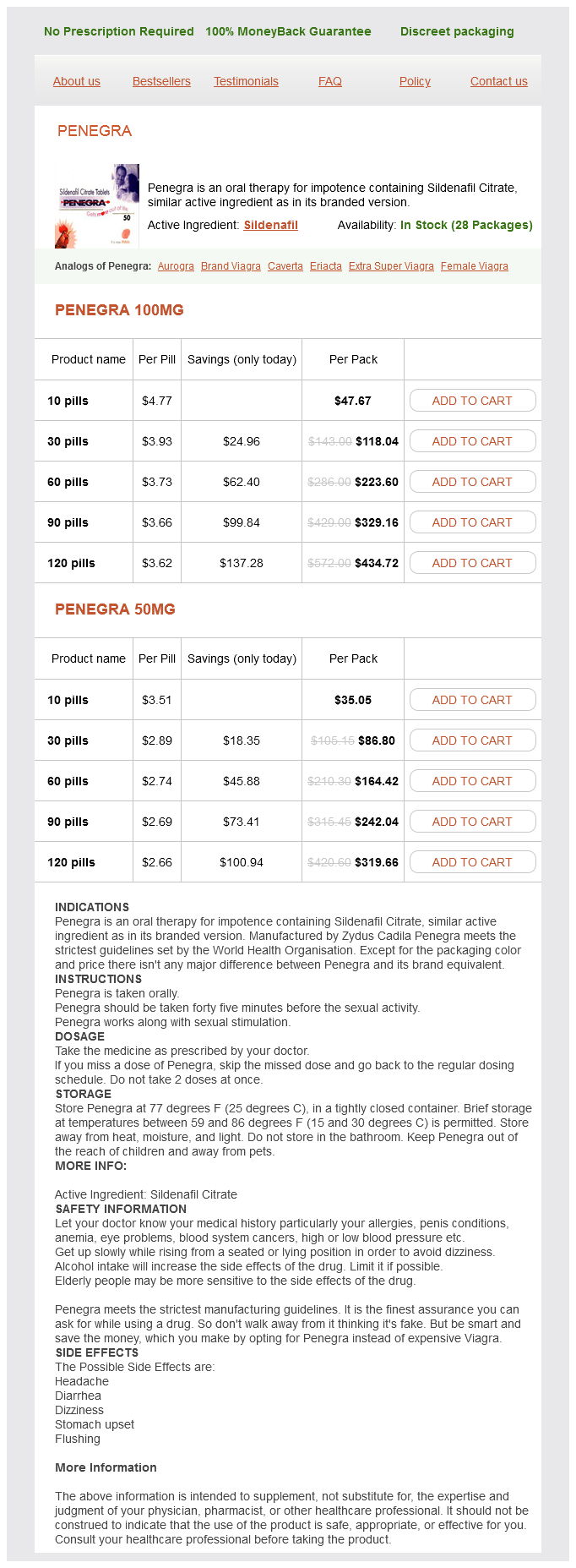
Penegra 100mg
Penegra 50mg
Penegra dosages: 100 mg, 50 mg
Penegra packs: 10 pills, 30 pills, 60 pills, 90 pills, 120 pills
In stock: 954
Only $2.76 per item
Nasal intubation is contraindicated if a basilar skull fracture is present or presumed androgen hormone jungle penegra 100 mg without a prescription. Once the airway is secured, attention must be paid to hemodynamics, as systolic blood pressure less than 80 mmHg is associated with a worse neurologic outcome. Fluid resuscitation and vasopressors are often needed to assure an adequate systemic and cerebral perfusion pressure. Intravascular access should include an arterial catheter and large-bore intravenous cannulae, and possibly a central venous line. Cross-matched red blood cells and other blood products should be available, and any available results relating to red blood cell counts and clotting function should be reviewed. Most patients are admitted to the neurointensive care unit after surgery and require continued intubation, mechanical ventilation, and sedation. Anesthesia for Spine Trauma and Complex Spine Surgery Spinal Cord Injury Acute spinal cord injury often necessitates emergency surgery to stabilize the spinal column and prevent secondary injury. Cervical spine injuries are most common, as this is the most mobile part of the spine. Cervical cord injuries cause more functional motor, sensory, and autonomic deficits than lower cord injuries. Also, higher cord injuries can impact respiratory muscle function to a greater extent with intercostal function being impacted by thoracic and cervical injuries and phrenic function being impaired by lesions at C5 or higher. Although voluntary respiratory effort remains with injury at the C4 level, vital capacity may be diminished by up to 25%. Spinal shock is characterized by sensorymotor deficits below the level of the injury and flaccid paralysis, usually lasting up to 6 weeks. Hypotension can result from autonomic impairment and hypovolemia associated with other injuries. Although primary injury may be due to stretching, compression, or transection of the spinal cord or its blood supply due to hyperflexion, hyperextension, or impingement of the fractured spinal column, secondary injury is a more complicated biochemical phenomenon involving the release of inflammatory mediators, cytokines, and amino acids leading to cellular edema, apoptosis, and free radical formation. Obviously during this time, lifethreatening injuries must be addressed, all the while ensuring that spinal alignment is maintained to avoid adding secondary injury to the spinal cord. They may also be more difficult to diagnose and treat in a patient for whom manipulation may be difficult or dangerous. Initial Management Patients presenting with acute spinal cord injury, depending on the level and extent of injury, may be compromised from a ventilatory and hemodynamic standpoint, and immediate control of these parameters is crucial. A detailed neurologic examination is critical to establish the operative plan and subsequent prognostication.
Balm of Gilead (Canada Balsam). Penegra.
Source: http://www.rxlist.com/script/main/art.asp?articlekey=96465
Examples of clear liquids include prostate wiki cheap penegra 50 mg amex, but are not limited to , water, fruit juices without pulp, carbonated beverages, clear tea, and black coffee (no alcohol). They found that the literature is insufficient to evaluate or support the effect of administering any of these classes of drugs on the perioperative incidence of emesis/reflux or pulmonary aspiration. Therefore, they could not recommend the routine preoperative use of such drugs for patients who have no apparent increased risk for pulmonary aspiration. Table 23-13 Summary of Fasting Recommendations for All Ages to Reduce the Risk of Pulmonary Aspiration Histamine-2 (H-2) Receptor Antagonists Meta-analyses of randomized placebo-controlled trials support the efficacy of the H-2 receptor antagonists cimetidine, ranitidine, and famotidine in reducing gastric volume and acidity. Multiple-dose regimens may be more effective in increasing gastric pH than a single dose before operation on the day of surgery. Cimetidine Cimetidine is usually administered in 150- to 300-mg doses orally or parenterally. The gastric effects of cimetidine last as long as 3 or 4 hours; thus, this drug is suitable for operations of that duration. Side effects of cimetidine include inhibition of the hepatic mixed-function oxidase enzyme system; therefore, it can prolong the half-life of many drugs, including diazepam, chlordiazepoxide, theophylline, propranolol, and lidocaine. The clinical significance of this after one or two preoperative doses of cimetidine is uncertain. Life-threatening cardiac dysrhythmias, hypotension, cardiac arrest, and central nervous system depression have been reported after cimetidine administration. These side effects may be especially likely to occur in critically ill patients after rapid intravenous administration. Ranitidine Ranitidine is more potent, specific, and longer acting than cimetidine. The usual oral dose of 150 mg or 50 mg given parenterally will decrease gastric fluid pH within 1 hour. It is as effective in reducing the number of patients at risk for gastric aspiration as cimetidine and produces fewer cardiovascular or central nervous system side effects. Thus, it may be superior to cimetidine at the conclusion of lengthy procedures in reducing the risk of aspiration pneumonitis during emergence from anesthesia and extubation of the trachea. Famotidine Famotidine is another H-2 receptor blocker that is given preoperatively to raise gastric fluid pH. The pharmacokinetics are similar to those of cimetidine and ranitidine, with the exception of having a longer serum elimination halflife than the other two drugs. Randomized controlled trials support their efficacy in reducing gastric volume and acidity. Oral doses of 40 mg to 80 mg must be given 2 to 4 hours before surgery to be effective.
M-mode prostate cancer in females penegra 100 mg order, or motion mode, adds temporal information to B-mode by displaying a series of sequentially collected B-mode images. M-mode echocardiography provides a onedimensional, single-beam view through the heart but updates the B-mode images at a very high rate, providing dynamic real-time imaging. The M-mode cursor is placed at the center of the aortic valve and the motion of the aortic 1830 cusps over time is shown. During diastolic coaptation, the aortic valve cusps appear as a thick, bright white line (long arrow), whereas in systolic apposition they form a "shoebox" (short arrow). Two-dimensional (2D) echocardiography is a modification of B-mode echocardiography and the mainstay of the echocardiographic examination. Instead of repeatedly firing ultrasound pulses in a single direction, the transducer in 2D echocardiography sequentially directs the ultrasound pulses across a sector of the cardiac anatomy. In this way, 2D imaging displays a tomographic section of the cardiac anatomy and, unlike M-mode, reveals the shape and lateral motion. Two-dimensional scanning is achieved using phased array technology, which sequentially activates each crystal in the array and thereby steers the beam without the transducer itself being moved. The two commonly used electronic scanning systems in medical ultrasound are the linear scanners and sector scanners. Groups of crystals are activated sequentially from one end of the transducer to the other. The firing of each group of crystals creates an image of the structures directly in front of them. With sequential firing, the anatomic features from one end of the transducer to the other are imaged. The disadvantage of this approach is that the transducer face must be large to cover a broad anatomic area. The linear array is commonly used to guide vascular access and regional anesthetic procedures. The resulting sector image, known as a frame, is similar in shape to that covered by a windshield wiper. The 2D scanner then repeats the entire process to update the image and capture motion. Illustration of the arced sector from a phased array twodimensional echocardiogram. Any structure that interacts with a scan line will create reflections (dark highlight); however, structures that lie between the scan lines are not interrogated and the echocardiography system averages the neighboring signals to fill in this defect.
Syndromes
Additional information:
Usage: q.d.
Tags: order penegra 100 mg fast delivery, purchase 50 mg penegra mastercard, cheap penegra 50 mg buy line, 100 mg penegra visa
Aila, 48 years: It has traditionally been used in cardiac surgery, because its vagolytic effects counteract the bradycardic effects associated with high-dose opioid techniques. Before initiating therapy, the transducer system should be examined quickly and the patency of the arterial cannula verified. Although local anesthetics can directly cause major disturbances to the heart, their effects on other components of cardiovascular systems may be just as important.
Jaroll, 45 years: In this case, breath sounds are very diminished or not audible over the contralateral side. An understanding of the pharmacokinetics of intravenous anesthetics is important to understanding their administration. The pressure gradient is defined as the difference in pressure from the "driving" chamber to the "receiving" chamber.
Esiel, 43 years: The unidirectional valve leaflets should be present and should move appropriately. Serious or permanent neurologic harm may occur after 1:20,000 to 35,000 neuraxial blocks. Alternatively, the tube exchange may be performed under direct vision using one of several commercially available video laryngoscopes, such as the GlideScope (Verathon Medical), C-Mac (Karl Storz), or the Mc Grath (Aircraft Medical) (see Chapter 28).
Barrack, 44 years: Because the stylet is rigid and its distal tip faces anteriorly, it may get caught on the anterior tracheal rings. The catheter-over-needle assembly offers greater stability and less leakage compared with the traditional counterpart in continuous interscalene nerve blocks: A randomized patient-blinded study. Typically, the block needle is advanced in sequence to reach each of the median, ulnar, and radial nerves.
Muntasir, 34 years: Fospropofol is a waterbased solution that yields less pain on injection, less hyperlipidemia, and less risk for bacteremia. Thiopental by comparison has a much longer context-sensitive half-time and is a poor choice to be used for continuous infusion. Stimulation may be performed magnetically or electrically, with the latter being the more common method.
Runak, 56 years: They often suffer from prolonged bleeding from minor injury, frequent epistaxis, and menorrhagia secondary to deficient or dysfunctional platelet activity. It is important to have a strategy to prevent the hazards 1754 related to using absorbents containing the problematic hydroxides that have desiccated. These factors underscore and explain why neostigmine-induced reversal of deep block may take upwards of 300 minutes, as recovery from this depth of block is mostly driven by spontaneous recovery.


