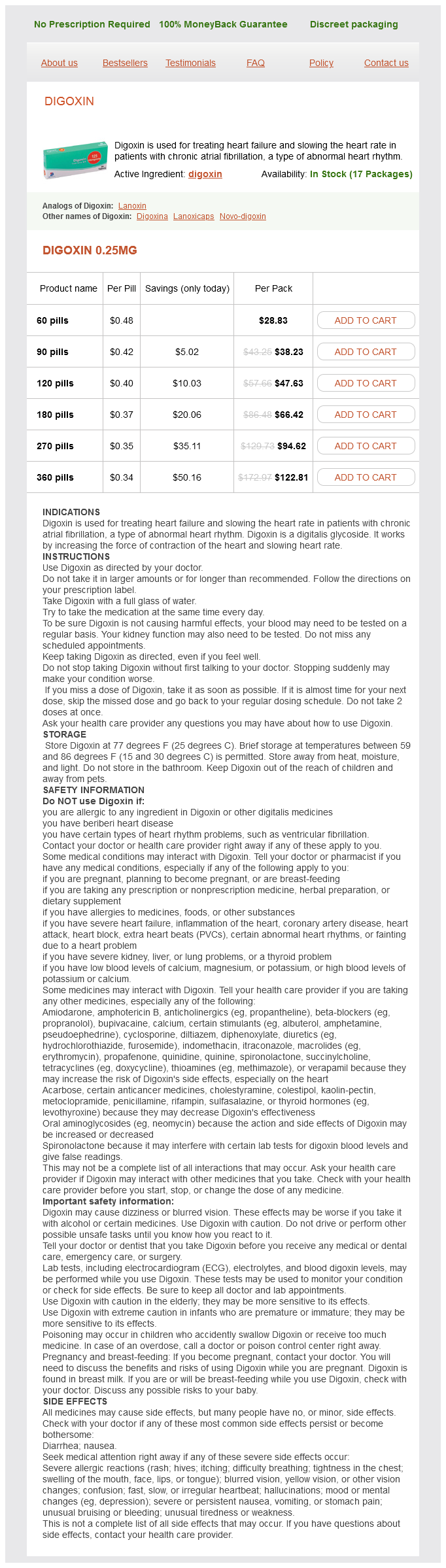
Digoxin 0.25mg
Digoxin dosages: 0.25 mg
Digoxin packs: 60 pills, 90 pills, 120 pills, 180 pills, 270 pills, 360 pills
In stock: 766
Only $0.36 per item
Some proven concepts are providing reminders to patients that vaccines are due and implementation of standing orders for vaccines blood pressure lowering order digoxin 0.25 mg on-line. Educate patients about the disease state, appropriate lifestyle modifications, and drug therapy required for effective treatment. If left untreated, patients experience a prolonged asymptomatic period followed by rapid, progressive immunodeficiency. Approximately 70% of these cases are in Sub-Saharan Africa, with a prevalence of approximately 5%. Central Asia, Eastern Europe, North Africa, and the Middle East are also seeing rapidly rising infection rates. After delivery, mothers are strongly recommended not to breast-feed if safe alternatives are available. These proteins assemble beneath the bilayer of the host cell, a nucleocapsid forms containing these proteins, and the virus buds from the cell. During the early stages of infection, approximately 10 billion virions can be produced each day. Most of the cells containing these viruses will be lysed as a result of budding virions, cytotoxic T-lymphocytes, or undergoing apoptosis. During this time, a high rate of viral replication can be seen in the lymph nodes. Taken together, these are the "acute retroviral syndrome," and 40% to 90% of acutely infected individuals will have symptoms. If patients are not identified during acute infection, they may later present with nonspecific symptoms such as myalgias, fatigue, weight loss, thrush, or symptoms associated with opportunistic infections. Acute Retroviral Syndrome the majority of patients may present with fever, lymphadenopathy, pharyngitis, and/or rash. In addition to these parameters, basic blood chemistry tests, liver function tests, complete blood counts, and lipid profiles should be monitored every 3 to 6 months in patients receiving antiretroviral therapy. Currently, combination antiretroviral drug therapy with three or more active drugs is the standard of care, which increases the durability of viral suppression and decreases the potential for the development of resistance. He reports having unprotected receptive anal intercourse with multiple male partners in the past year. Last week, he presented to the urgent care clinic with complaints of fever, malaise, and pharyngitis. Once the decision is made to initiate treatment, the regimen is selected based on patient-specific factors. Nonpharmacologic Interventions Patient adherence is a key component in treatment success. Drug therapy is required for a lifetime, as the virus begins to replicate at high levels when medications are stopped. Advances in delivery and formulations now make possible once- or twice-daily dosing with fewer pills per day.
Ground Furze (Spiny Restharrow). Digoxin.
Source: http://www.rxlist.com/script/main/art.asp?articlekey=96448
Studies have reported an incidence of about 85% in head and neck cancer patients receiving chemoradiation arrhythmia joint pain 0.25 mg digoxin order mastercard. Administering palifermin within 24 hours of chemotherapy can result in an increased sensitivity of rapidly dividing epithelial cells to the cytotoxic agent. For this reason, palifermin should not be administered for 24 hours before, 24 hours after, or during the infusion of myelotoxic chemotherapy to avoid increasing the severity and the duration of oral mucositis. Outcomes measured in clinical trials often assess the incidence, duration, and severity of mucositis with a given intervention intended to prevent or treat mucositis. Agents that are intended to palliate the symptoms of mucositis are usually assessed by measures in pain scales and the ability to eat or drink. Patients frequently require hospitalization for prompt administration of broad-spectrum antibiotics that are critical to avoid morbidity and mortality. The causes of this change are attributed to the widespread use of central venous catheters and more aggressive chemotherapy regimens as well as the use of prophylactic antibiotics with relatively poor gram-positive coverage (quinolones). Although gram-negative infections are less common, they cause the majority of infections in sites other than the blood and are particularly virulent. It should be noted that isolates vary considerably among institutions; thus, attention to institutional isolation patterns is prudent. From the 1960s through the mid-1980s, gram-negative organisms were the most common bacteria isolated. This pattern shifted to the gram-positive organisms in the late 1980s, which remain the most common isolates. Recent data indicate that gram-positive organisms account for 62% to 76% of all bloodstream infections. These organisms are provided access to the bloodstream through breakdowns in host defense barriers (mucositis, use of central venous catheters). Note: A risk-index score of 21 or higher indicates that the patient is likely to be at low risk for complications and morbidity. The Multinational Association for Supportive Care in Cancer risk index: A multinational scoring system for identifying low-risk febrile neutropenic patients. Some patients are at lower risk and could potentially be treated as outpatients, thereby avoiding the risk and cost of hospitalization. Hand Hygiene As previously discussed, most infections in neutropenic patients are a result of endogenous flora; however, prevention of further acquisition of environmental pathogens is also important. Patients who are or will become neutropenic should practice careful handwashing and avoid contact with people who neglect hand hygiene. In addition, ingestion of certain fresh fruits and vegetables as well as unprocessed dairy products should be avoided during the neutropenic period. Practitioners should also engage in vigilant hand hygiene after each patient encounter to limit the spread of infections between patients. If prophylactic quinolone use is adopted, changes in local patterns of resistance should be closely monitored. Signs and Symptoms · Fever is typically the only sign of infection, although septic patients may have chills.
The potential for pharmacokinetic drug interactions is an important issue to consider during the development of new drugs heart attack treatment 0.25 mg digoxin purchase fast delivery. In the past, drug interactions were mainly discovered serendipitously, often as a consequence of an unexpected change in the clinical status of a patient after the addition or a withdrawal of a drug from existing medication regimen. As the risk of a drug interaction is an undesirable property of a drug, such an information should ideally be obtained before in the preclinical phase. Preclinical characterization of drug interactions includes the usue of in vitro enzyme systems and animal models [36]. While experimental studies in animal models are time-consuming and require much expertise, in vitro methodologies are extremely useful to characterize and identify potential drug interactions before a drug reaches the clinical phases of development. In recent years, different preclinical in vitro methods have been developed and have become widely used as screening tools to assess and predict metabolic drug interactions. These methodologies include enzyme-based techniques, such as purified enzymes, recombinant human enzymes and human liver microsomes, and cell-based techniques, such as liver slices, immortalized cell lines and primary hepatocytes. Each method has its advantage and disadvantage, and the readers are referred to other review articles for further information on this topic [37,38]. First, it is essential to identify the metabolic pathway(s) and the enzymes responsible for the biotransformation of the drug and to determine the relative contribution of each metabolic pathway to its overall elimination. This approach allows the prediction of interactions affecting the metabolism of the test compound. Once the role of different isoenzymes to the metabolism of a given drug has been elucidated, prediction of interactions affecting the biotransformation of that drug can easily be made, based on existing knowledge of the influence that other compounds have on the activity of the same isoenzymes. Secondly, it is necessary to evaluate the potential of the test drug to inhibit or induce the activities of the various drug-metabolizing enzymes. This allows the prediction of any effect that the test compound may have on the metabolism of other drugs. A good correlation between the ability to inhibit various enzyme systems in vitro and the in vivo inhibitory interaction profile has been established for valproic acid [40,41,42]. However, extrapolating data in vitro to in vivo can be challenging because different models are used. As a result, intermodel predictions may vary 10- to 20-fold, as highlighted by the comparison of rat hepatocytes and microsomes with differences in uptake transport [43,44]. Therefore, after an in vitro assessment of the pharmacokinetic features of a drug, clinical studies are needed to confirm its occurrence and magnitude in vivo. In fact, co-administration of two substrates of the same enzyme, or co-administration of a substrate with an inhibitor or an inducer, entails the possibility of a drug interaction.
Syndromes
Additional information:
Usage: q.i.d.
Tags: digoxin 0.25 mg buy cheap, buy digoxin 0.25 mg with visa, cheap digoxin 0.25 mg online, order digoxin 0.25 mg visa
Jensgar, 28 years: Adverse reactions to intravenous diazepam: a report from the Boston Collaborative Drug Surveillance Program. In such situations, treatment strategies may be instituted following endocrinological referral. Traditional chemotherapy agents have some similar side effects, usually manifested on the most rapidly proliferating cells of the body. Vasoconstriction can occur due to decreased levels of endothelium-derived vasodilators, as well as in the presence of other risk factors, including hypertension, dyslipidemia, and smoking.
Nerusul, 61 years: This may be compounded by the frequent use of antacids in the elderly, which can specifically impair the absorption of phenytoin [59]. Often of over-riding importance is the treatment of the underlying causative condition. Bleomycin has shown clinical activity in the treatment of patients with testicular cancer and malignant effusions, squamous cell carcinomas of the skin, and Kaposi sarcoma. Metabolic adverse effects Reactions affecting the liver and pancreas Drug-induced liver toxicity can be caused by immune-mediated mechanisms or by direct cytotoxic damage.
Ballock, 50 years: The malignant cells that split from the primary tumor find a suitable environment for growth. For example, the frequency of skin rashes induced by a variety of antiepileptic drugs has been found to be twice as high in women as in men [98]. Without interruption, the neurochemicals ultimately lead to a firing of the unmyelinated or thinly myelinated afferent neurons. Clinical diagnosis can be confirmed by documenting elevated urinary sialylyl-oligosaccharides and a deficiency of -N-acetylneuroaminidase in leucocytes and cultured skin fibroblasts [130].
Grubuz, 35 years: Disease is spread by direct extension, peritoneal seeding, lymphatic dissemination, or bloodborne metastasis. Each time ovulation occurs, the ovary epithelium is disrupted, and cell damage occurs. Herbs and animal products are often mixed and cooked in ghee or oils to make them more palatable. It appears that the neuronal damage that occurs during status epilepticus is not necessary for epileptogenesis [44,45] and indeed there is some evidence that damaging the hippocampus through severe hypoxic injury, for instance, seems to inhibit epileptogenesis [46].
Carlos, 37 years: Premedication with midazolam in children: effect of intranasal, rectal and oral routes on plasma midazolam concentrations. Endocrine therapy is not indicated for tumors that do not express at least one of the hormone receptors. It has therefore been suggested that for women taking lamotrigine, the combined contraceptive pill can be used with tricycling or continuous use to avoid fluctuations in lamotrigine serum concentrations during the pill-free weeks [21,22]. To improve adherence with therapy, the practitioner should discuss with the patient what options are available and what her preferences are.
Mirzo, 22 years: Deposition of uric acid and calcium phosphate crystals in the renal tubules can lead to acute renal failure. Recognize typical presenting signs and symptoms of common complications and emergencies that require supportive care interventions. Unfortunately, some tumor markers are nonspecific and may be elevated from nonmalignant causes. Outcome Evaluation Treatment of the acute phase of the disease (ie, fever, malaise, edema of the face, and hepatosplenomegaly) is nifurtimox.
Raid, 58 years: These treatment goals are best achieved by appropriate parenteral antimicrobial therapy, including empirical therapy to cover the most likely pathogens, followed by directed therapy after culture and sensitivity results are known. For example, many fluoroquinolone antimicrobials are partially metabolized and undergo renal elimination. In recent years, the importance of ketosis in the mechanism of action of the ketogenic diet has been questioned [30]. For most cases of primary peritonitis, drainage procedures may not be required, and antimicrobial agents become the mainstay of therapy.


