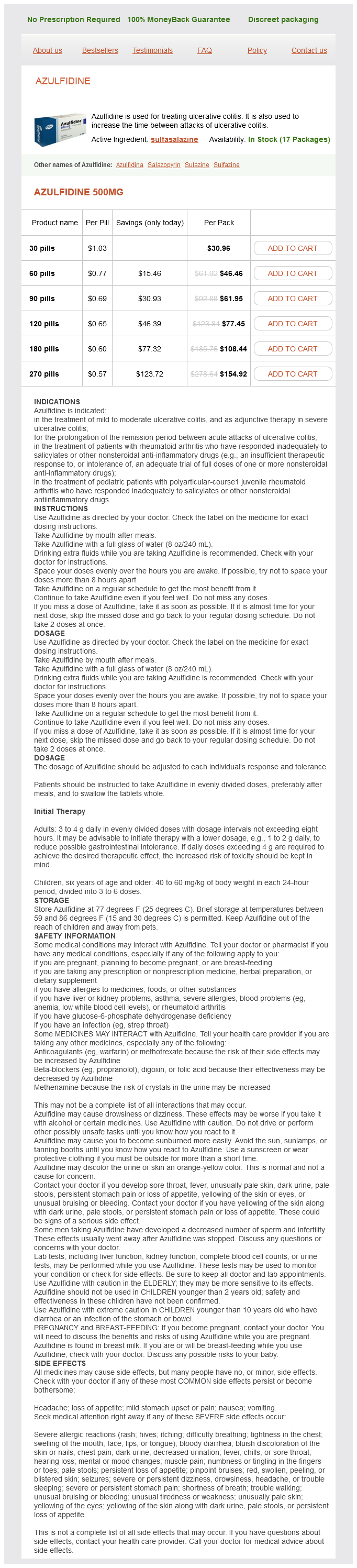
Azulfidine 500mg
Azulfidine dosages: 500 mg
Azulfidine packs: 30 pills, 60 pills, 90 pills, 120 pills, 180 pills, 270 pills
In stock: 853
Only $0.61 per item
Timing of extubation is as important as back pain treatment uk generic azulfidine 500 mg buy online, if not more important than, initial airway management, since significant postsurgical edema and in-situ distraction devices may be present that will make rescue mask ventilation and intubation extremely difficult or impossible. Some patients should be kept intubated for several days until better extubation conditions exist. Midface Hypoplasia Whereas syndromes with mandibular hypoplasia have underdevelopment of the lower half of the face, disorders with midface hypoplasia result in underdevelopment of the eye sockets, cheek bones, and upper jaw. Growth deficiency of the midface produces a characteristic concave appearance with wide-set eyes (hypertelorism) that are often proptotic, flattened nasal bridge, as well as a large underbite. Syndromic midface hypoplasia is frequently associated with multiple other congenital anomalies such as craniosynostosis, syndactyly, and congenital heart disease. Achondroplasia (dwarfism) is a well-recognized disorder featuring midface hypoplasia. The cranium, midface, and bones and soft tissues of the hands and feet are affected. The result is a combination of craniosynostosis, midface hypoplasia, and symmetric syndactyly of the extremities with cutaneous and bony fusion. Turribrachycephaly (towering of the skull), hypertelorism, and low-set ears are also prominent features. Occasionally, choanal atresia, tracheal stenosis, cervical spine fusion, congenital heart defects, and genitourinary anomalies are also present. Obstructive sleep apnea is common and must be addressed early to avoid development of cor pulmonale. Eye complaints include proptosis and exophthalmos predisposing to corneal injury, amblyopia, strabismus, and optic nerve atrophy. Preparations for a potentially difficult airway must be made, as would be done in any case with an anticipated challenging airway. Given the characteristic proptosis, special attention must be paid to the eyes to avoid corneal and compression ophthalmic injury. Specifically, it is a cellulitis of the stratified squamous epithelium of these structures, including the lingular surface of the epiglottis, the aryepiglottic folds, and the arytenoids. Subglottic structures, including the laryngeal surface of the epiglottis, are generally spared. Also known as craniofacial dysostosis (malformation of the face and skull bones), it is a hereditary disorder (autosomal dominant) characterized by craniosynostosis, midface hypoplasia, mandibular prognathism, and shallow eye sockets with hypertelorism and proptosis. As a result of frequent premature fusion of the coronal sutures, brachycephaly (short and broad head) is usually seen.
Agracejo (European Barberry). Azulfidine.
Source: http://www.rxlist.com/script/main/art.asp?articlekey=96443
In every patient with back pain pain treatment center hattiesburg ms order 500 mg azulfidine, it is essential to systematically ask about and look for the clinical clues and pivotal points associated with serious causes of back pain (Table 7-1). In patients with positive findings, the initial patient-specific differential is quickly limited to serious systemic causes of back pain or specific musculoskeletal back pain. Also note that the patellar reflex reflects L4 function, and the Achilles reflex reflects S1 function. Y felt well until 1 week ago, when he helped his girlfriend move into her third floor apartment. Although he felt fine while helping her, the next day he woke up with diffuse pain across his lower back and buttocks. He feels better when he is in bed and had transiently worse pain after doing his usual weight lifting at the gym. History and physical exam should focus on looking for neurologic signs and symptoms that would suggest a specific musculoskeletal cause, such as a herniated disk, and for signs and symptoms that would suggest the presence of a systemic disease. Signs and symptoms of neurologic or systemic disease are pivotal points in the assessment of back pain. It is necessary to further explore the differential by looking for findings listed in Tables 7-1 and 7-2. The clinical clues (sometimes called "red flags") listed in Table 7-1 should be assessed in all patients with back pain. On physical exam, he has mild tenderness across his lower back; lower extremity strength, sensation, and reflexes are normal. The exploration does not undercover new findings suggestive of specific or serious causes of back pain, limiting the differential at this point to nonspecific, mechanical low back pain. Leading Hypothesis: Mechanical Low Back Pain Textbook Presentation the classic presentation is nonradiating pain and stiffness in the lower back, often precipitated by heavy lifting. Often occurs hours to days after a new or unusual exertion and improves when the patient is supine, but patients do not always identify a specific precipitant C. New neurologic abnormalities on history or physical exam should prompt investigation of another diagnosis. Risk factors for persistent low back pain, which occurs in 1015% of patients, include a. Presence of "nonorganic signs" (signs suggesting a strong psychological component to pain, such as superficial or nonanatomic tenderness, overreaction, nonreproducibility with distraction, nonanatomic weakness or sensory changes) Evidence-Based Diagnosis A. The absence of all red flags is 99% predictive of a nonserious etiology of low back pain. Even in symptomatic patients, anatomic abnormalities are not necessarily causative, and identifying them does not influence initial treatment decisions.
An inadequate host response pain treatment elderly buy 500 mg azulfidine with visa, rather than inappropriate antibiotic therapy or unexpected microorganisms, is the most common cause of apparent antibiotic failure when guidelinerecommended therapy is used. Decisions regarding further diagnostic testing and antibiotic change/escalation are intimately intertwined and need to be discussed in tandem. In a different study, mortality among patients with microbiologically guided versus empirical antibiotic changes was not improved (mortality rate, 67% vs. However, no antibiotic changes were based solely on sputum smears, suggesting that invasive cultures or nonculture methods may be needed. Mismatch between the susceptibility of a common causative organism, infection with a pathogen not covered by the usual empirical regimen, and nosocomial superinfection pneumonia are major causes of apparent antibiotic failure. Therefore, the first response to nonresponse or deterioration is to reevaluate the initial microbiological results. Culture or sensitivity data not available at admission may now make the cause of clinical failure obvious. In addition, a further history of any risk factors for infection with unusual microorganisms (table 8) should be taken if not done previously. Other family members or coworkers may have developed viral symptoms in the interval since the patient was admitted, increasing suspicion of this cause. The evaluation of nonresponse is severely hampered if a microbiological diagnosis was not made on initial presentation. If cultures were not obtained, clinical decisions are much more difficult than if the adequate cultures were obtained but negative. Risk factors for nonresponse or deterioration (table 12), therefore, figure prominently in the list of situations in which more aggressive initial diagnostic testing is warranted (table 5). Deteriorating patients have many of the risk factors for bacteremia, and blood cultures are still high yield even in the face of prior antibiotic therapy [95]. Positive blood culture results in the face of what should be adequate antibiotic therapy should increase the suspicion of either antibiotic-resistant isolates or metastatic sites, such as endocarditis or arthritis. Despite the high frequency of infectious pulmonary causes of nonresponse, the diagnostic utility of respiratory tract cultures is less clear. Caution in the interpretation of sputum or tracheal aspirate cultures, especially of gram-negative bacilli, is warranted because early colonization, rather than superinfection with resistant bacteria, is not uncommon in specimens obtained after initiation of antibiotic treatment. This finding may be a partial explanation for the finding that fluoroquinolones are associated with a lower incidence of nonresponse [84]. Stopping the b-lactam component of combination therapy to exclude drug fever is probably also safe [156]. Because one of the major explanations for nonresponse is poor host immunity rather than incorrect antibiotics, a positive pneumococcal antigen test result would at least clarify the probable original pathogen and turn attention to other causes of failure. In addition, a positive pneumococcal antigen test result would also help with interpretation of subsequent sputum/tracheal aspirate cultures, which may indicate early superinfection. The pattern of opacities may also suggest alternative noninfectious disease, such as bronchiolitis obliterans organizing pneumonia.
Syndromes
Additional information:
Usage: q._h.
Tags: 500 mg azulfidine free shipping, order azulfidine 500 mg otc, 500 mg azulfidine purchase fast delivery, azulfidine 500 mg amex
Olivier, 34 years: Delirium is estimated to affect 10% to 30% of elderly patients hospitalized for medical illness.
Bandaro, 60 years: Inpatient management (1) the optimal dose of benzodiazepines cannot be determined in advance and must be titrated to the particular needs of the patient.
Goose, 62 years: Can be used as monotherapy or in combination with sulfonylureas, metformin, and insulin.
Nefarius, 59 years: In the study by Colacci et al (1991), no significant difference in binding was noted between multiple tissue (liver, kidney, lung, and stomach), and there was no increase in binding with phenobarital pretreatment.
Kliff, 25 years: There is no gold standard anesthetic approach, and controversy still exists regarding whether to maintain spontaneous ventilation or to initiate controlled ventilation.


