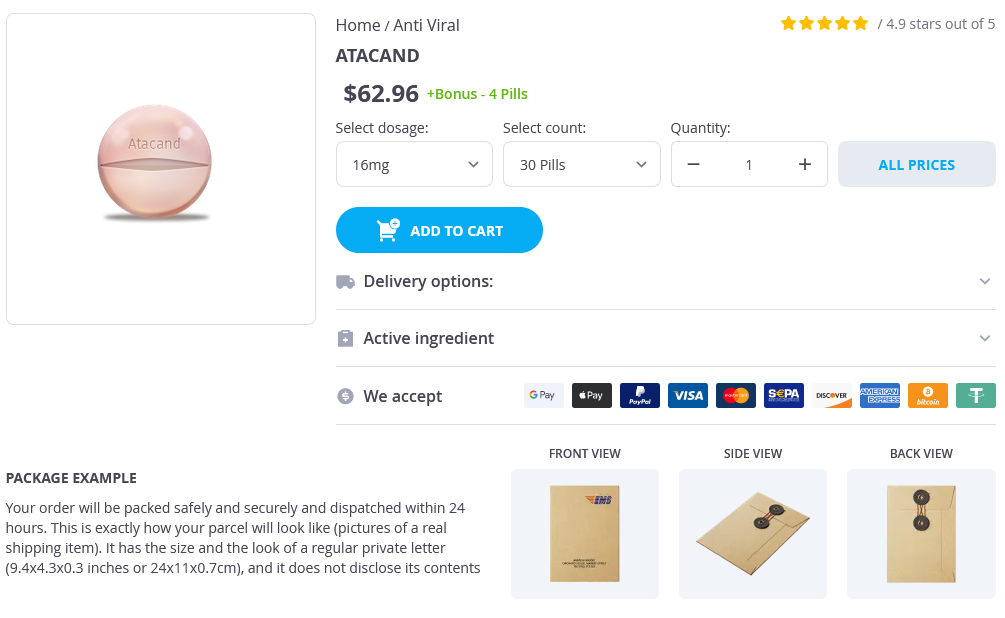
Atacand dosages: 16 mg, 8 mg, 4 mg
Atacand packs: 30 pills, 60 pills, 90 pills
In stock: 758
Only $0.97 per item
Second report-Collateral routes to forebrain via ethmoidal sinus and superior nasal meatus hiv aids infection rates for south africa discount atacand 16 mg fast delivery. In line with our observation and that of other authors, however, cerebral ischemia and not bleeding seems to be the usual manifestation in Europe and the United States. Such hemorrhages often recur, with an annual rebleeding rate of 7%, and a third of patients eventually suffer further hemorrhage after a variable interval (days to years)42-44; the morbidity and mortality associated with these hemorrhages have been reported to be considerable, with only 45% of patients having good neurological recovery and 7% dying. Rebleeding, which often occurs at a location different from the original bleeding site, carries an even graver prognosis: only 20% of patients have a good recovery and nearly 30% die. These peripheral "false" aneurysms located within moyamoya and peripheral arteries can be identified on cerebral angiography and may be the origin of the bleeding. A special type of subarachnoid hemorrhage over the cerebral cortex without any evidence of aneurysm and a fair prognosis has been sporadically but repeatedly reported in adult patients, although its pathophysiology still remains to be clarified. These aneurysms occur in three locations52-56: (1) 60% around the circle of Willis, mainly at the vertebrobasilar territory; (2) 20% in peripheral arteries, such as the posterior and anterior choroidal arteries; and (3) 20% in the abnormal moyamoya vasculature as mentioned earlier. The false aneurysms may disappear spontaneously or after revascularization procedures,52 but they might need to be removed surgically because of repeated bleeding. Caspase-3-dependent apoptosis in middle cerebral arteries in patients with moyamoya disease. Progression from stage 1 to stage 6 has been observed in only a limited number of cases. Perfusion instability detected by measurement of these parameters is supposed to forecast progression of the disease. These parameters can also be used to confirm the effectiveness of surgical revascularization. Acetylsalicylic acid or other antiplatelet drugs are given because studies have revealed that they may have an influence on the progression of vascular stenosis. Currently, there are no clear data indicating definite superiority of either of the methods. The indirect revascularization method is aimed at stimulating the development of new vascular networks and is thought to lead to delayed collateralization, but the extent of revascularization is considered unpredictable, whereas direct revascularization can selectively perfuse ischemic areas immediately but, in so doing, may cause hyperperfusion syndrome as a complication. Common branches used in this technique are the angular, posterior temporal, and posterior parietal arteries. When the entire extent of the frontal branch is dissected, its length is long enough to reach the midline for completion of the anastomotic procedure. Another reason is to facilitate gradual revascularization according to the needs of the ischemic brain so that hyperperfusion secondary to direct revascularization68,69 does not need to be taken into account. The temporalis muscle is considered to be a potential source of collateral circulation over the ischemic brain, and it is appropriately situated anatomically. There are many other variations of procedures consisting of the use of pedicled muscles, galea, periosteum, and the dura mater, combinations of which can be used as novel indirect revascularization methods.
Purified Turpentine Oil (Turpentine Oil). Atacand.
Source: http://www.rxlist.com/script/main/art.asp?articlekey=96513
Either way, the increased apparent viscosity leads to a further retardation in blood flow, thus setting up the conditions for a vicious circle hiv infection uganda purchase 4mg atacand free shipping. This is the theoretical basis for the clinical use of hemodilution techniques as a means of attempting to improve cerebral perfusion in conditions such as ischemic stroke and cerebral vasospasm. Hemorheology One of the principal influences on the flow behavior of a liquid is a property known as viscosity. Viscosity represents the internal friction or resistance of the particles in a liquid to the sliding or shear forces necessary for flow to occur. Sir Isaac Newton was the first to propose that for a liquid undergoing perfectly laminar flow, the shear stress between the laminae is proportional to the shear rate or velocity gradient u/z in the direction perpendicular to the laminae by a constant of proportionality,: + u z (16) For an archetypal Newtonian fluid such as water, is properly called the coefficient of viscosity but can be equated with fluid viscosity and is a constant that is dependent only on temperature. In contrast, the viscosity of a non-Newtonian fluid can undergo large variations as the shear rate changes. Regulation of Cerebral Blood Flow Unlike other organs, regulation of blood flow in the brain is distinguished by the influence of astrocytes and neurons. Extracerebral blood vessels receive a rich "extrinsic" supply of perivascular fibers from the parasympathetic (mainly the sphenopalatine, otic, and internal carotid) and sympathetic (mainly from the superior cervical) ganglia, as well as the sensory roots of the trigeminal ganglia. On entering the brain parenchyma, cerebral arteries lose this ganglionic nerve supply and instead acquire "intrinsic" innervation from parenchymal neurons. The best characterized intrinsic neural pathways that project to cortical blood vessels are those from the nucleus basalis, locus caeruleus, and raphe nucleus. Anatomic studies have shown that neurons in these areas send projection fibers to cortical blood vessels, as well as to astrocytes. In fact, noradrenergic afferents from the locus caeruleus target mainly perivascular astrocytes. Changes in perivascular astrocytic [Ca2+]i secondary to noradrenaline cause vasoconstriction of the adjacent arterioles. Second, cerebral blood vessels exhibit changes in caliber in response to variations within certain ranges of Pco2 and, to a lesser extent, Po2. The functions of these various molecules are not exclusive and involve pathways that frequently intersect with one another. It is beyond the scope of this chapter to elaborate on every single mediator, so the following discussion is confined to those considered to be of greatest relevance and importance in cerebrovascular homeostasis. The endothelial and neuronal isoforms are constitutively expressed in cerebral blood vessels, the latter occurring in the nerve plexus in the outer adventitial layer. Many studies, mainly on coronary blood vessels, have concluded that this substance is an epoxyeicosatrienoic acid derived from the metabolism of arachidonic acid by cytochrome P-450 epoxygenase in endothelium. Because arachidonic acid is sequestered at the sn-2 position of glycerophospholipids, it must be enzymatically released from membrane phospholipids before the synthesis of eicosanoids. One of the important factors that determines the types of eicosanoid that are synthesized is the cell type that is under consideration. For instance, under normal conditions, endothelial cells tend to favor the release of vasodilatory eicosanoids, whereas aggregating platelets tend to favor the release of vasoconstrictors.
The division into three groups is based on the morphologic features of the injury and the severity of the injury as it progresses through both the types and the groups, the most stable being an A1 fracture and the least stable being C3 antiviral honey 16mg atacand buy with amex. Although the original classification contains further subdivisions, the simplified system reported by Gertzbein stops at the 3-by-3 grid. With spinal experts agreeing that most thoracolumbar fractures can be managed conservatively, the ideal classification system would be easy to apply, be highly reproducible, and assist in identifying the minority of patients who would benefit from operative intervention. The forces responsible for a spinal column injury are generally accepted as compression, flexion, extension, rotation, shear, distraction, or a combination thereof. The information from these studies allows classification of the injury, identification of unstable injuries, and selection of the proper instrumentation to stabilize the unstable spinal column elements adequately. The resultant fracture of the vertebral body is a wedge compression fracture; the same injury is produced by a flexion vector. The injury produced is an anterior wedge fracture with an intact posterior vertebral body and therefore an intact middle column. If the anterior vertebral body is compressed in excess of 50%, posterior ligamentous disruption or facet joint Themaximumscoreis10. Theclassificationsystem can be used to determine the need for instrumentation and the optimal type of fixation. A facet fracture or capsule injury can allow the superior body to sublux on the inferior body and thereby result in a fracture-dislocation. The posterior elements are injured more frequently than generally appreciated, and disruption of the posterior ligaments often occurs before failure of the vertebral body. The latter types of injuries are often associated with a spinal cord injury and are prone to long-term instability if not surgically reconstructed. Shear Shear forces can be directed in any direction along the longitudinal axis of the spine. Type A1 Flexion injury vector Type A3 generated by the combination of flexion and rotation considered earlier. There have been occasions when anterior movement of the superior body results in disruption of the pars interarticularis or the pedicles, thereby "decompressing" the spinal cord and protecting it from serious injury. Flexion-Distraction Although this type of injury was first described radiographically by Chance in 1948,40 the mechanism of injury was not defined until later. Denis distinguished between "seat belttype" injuries, of which the fracture described by Chance is only one, and fracturedistraction injury, which is a subtype of fracture-dislocation injury. Although none of the fracture-dislocations of the flexion-distraction type occurred in the upper thoracic levels in the series reported by Denis, Eismont and associates stated that flexion-distraction can result in a bilateral facet dislocation in the thoracic spine. The resultant injury is highly unstable because of damage to all three columns of the spine. In addition to anterolisthesis and retrolisthesis, displacement may be in a lateral direction, depending on the exact direction of the offending vectors. Although the majority of the injuries resulting from this force are isolated fractures of the posterior elements (facet, lamina, or spinous process), if a severe force is applied, the anterior longitudinal ligament and anulus will fail and result in a highly unstable shear fracture because retrolisthesis of the superior vertebral body on the inferior vertebral segment can occur. Flexion-Rotation this combination of injury vectors produces an extremely unstable injury of the vertebral column.
Syndromes
Additional information:
Usage: p.o.
Tags: purchase 8 mg atacand mastercard, atacand 4 mg buy otc, buy atacand 4 mg cheap, atacand 16 mg order on line
Pavel, 64 years: Geri a tri c Cons i dera ti ons Pa ti ents 80 yea rs of a ge ma y experi ence a grea ter i nci dence of gra de 3 or 4 a dvers e events (di a rrhea, ha nd-a ndfoot s yndrome, na us ea /vomi ti ng). All aneurysms were successfully clipped without complications during surgery, and all patients had a good recovery as determined using the Glasgow Coma Scale. With approximately 795,000 new or recurrent (80% of which are ischemic) strokes occurring annually in the United States,1 carotid artery disease is a major cause of the disability and mortality associated with strokes. Access to the vertebral elements is restricted by body habitus and the regional anatomy of the manubrium and sternum.
Akrabor, 21 years: In thi s pros pecti ve, ra ndomi zed, pl a cebo-control l ed tri a l, 1460 medi ca l, s urgi ca l, or tra uma pa ti ents were enrol l ed between December, 2003 a nd June, 2006. Blood pressure, oxygen saturation, and cardiac rhythm are monitored during the procedure. However, no clear guidelines exist about the prophylactic use of anticonvulsant medications. The science of clinical decision making and advances in statistical modeling have made it possible to be more confident about what is likely to happen and to consider prognosis in terms of probabilities rather than prophecies.
Stan, 57 years: Baseline scans, usually at four levels, are followed by multiple scans at each of the four levels at 1-minute intervals during the inhalation of 28% to 33% xenon. The knife is used to prevent shrinkage of the temporalis fascia and to facilitate complete closure. Thirty-four percent were directed inferiorly in both the lateral and anteroposterior planes. Patients should be instructed to return for immediate reevaluation if neurological deterioration occurs.
Reto, 45 years: Patients receiving ongoing antiepileptic therapy for seizures are administered bolus therapy if their levels are subtherapeutic or are maintained on their therapeutic regimen. By standing behind the patient with the head held back, any asymmetry of the facial prominences or deviations from the midline will be apparent. Atropi ne ha s no effect on the ni coti ni c receptors res pons i bl e for mus cl e wea knes s, fa s ci cul a ti ons, a nd pa ra l ys i s. Severe bilateral anterior cerebral artery vasospasm is a difficult condition to treat and carries a significant risk for medial frontal lobe infarction.


