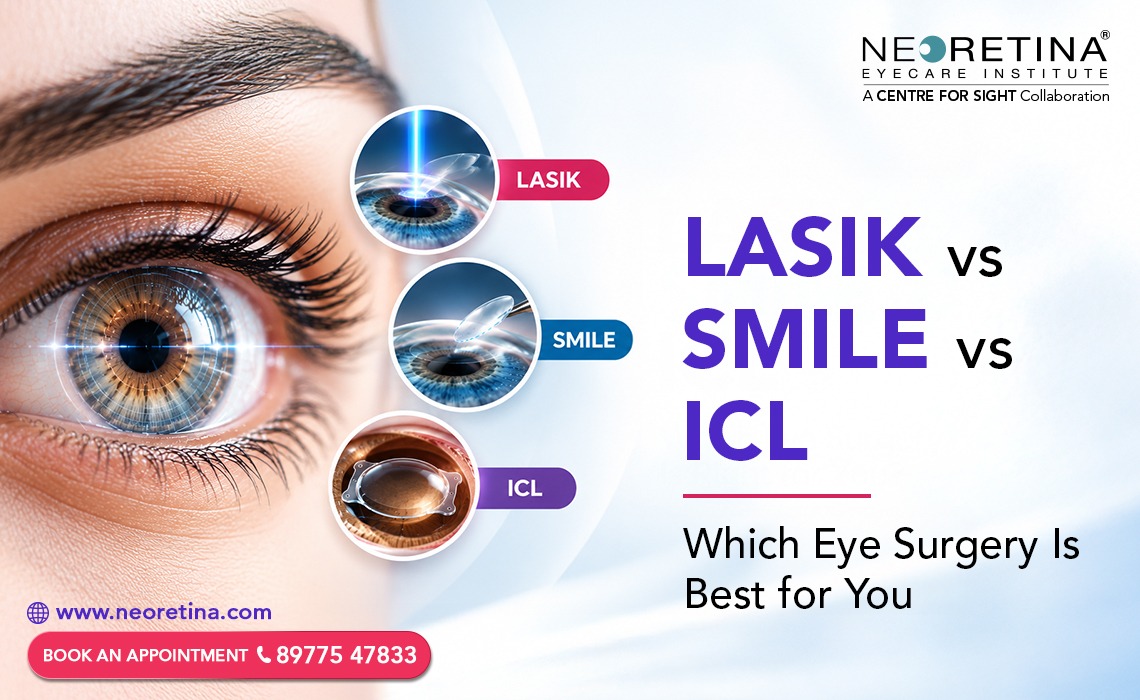
Clear vision without the need for glasses or contacts is what many people suffering from refractive errors desire. Modern Eye Surgery has several procedures for the correction of such vision problem as LASIK, SMILE, and ICL. These processes help correct various refractive problems, among which is myopia.
However, the processes of vision correction differ in mechanisms and impacts on the eyes. The difference between LASIK, SMILE, and ICL will help one understand which of these procedures suits their needs in vision correction the most.
In this guide, we are going to discuss the workings of these methods, their pros and cons, and other factors that the doctor takes into account before recommending them.
LASIK vs SMILE vs ICL: How the Three Really Compare
LASIK, SMILE, and ICL are the three common procedures employed to solve the issues created by refractive errors. While all three procedures are commonly known for correcting refractive errors, they are also different from each other since they involve different ways of doing things.
LASIK and SMILE employ lasers to correct the shape of the cornea, while ICL involves the insertion of a lens into the eye.
Comparison Table: LASIK vs SMILE vs ICL
| Feature | LASIK | SMILE | ICL |
| Full form | Laser-Assisted In Situ Keratomileusis | Small Incision Lenticule Extraction | Implantable Collamer Lens |
| Procedure | Creates a corneal flap and reshapes the cornea | Removes a small piece of corneal tissue through a small incision | Places a corrective lens inside the eye |
| Technology | Excimer and femtosecond lasers in common modern techniques | Femtosecond laser | Surgical lens implantation |
| Best suited for | Selected patients with myopia, with or without astigmatism | Selected patients with myopia, with or without astigmatism | Selected patients, including some with high myopia |
| Corneal tissue | Reshapes corneal tissue | Removes a small amount of corneal tissue | Does not reshape the cornea |
| Dry eye considerations | May cause or worsen dry eye | May have a lower risk of postoperative dry eye in some patients | Does not involve corneal reshaping |
| Reversibility | Permanent corneal reshaping | Permanent corneal reshaping | Lens can be removed or exchanged surgically |
| Recovery | Often rapid | Often rapid | Usually several days to weeks for full recovery |
It is important to know that different procedures work well for different individuals depending on many things, including prescription strength, cornea thickness, overall health, age, and even personal expectations.
LASIK Eye Surgery: What Is It?
It is the surgical process for correcting vision through lasers.
During the process, the cornea, which is the clear front surface of the eye, is reshaped in order to enable more accurate focus of light onto the retina.
The surgery is common due to its quick visual results.
Mechanism of LASIK Surgery
Steps involved in LASIK
- Anaesthetising the eye: Eye drops containing an anaesthetic agent are used to prevent pain during the procedure.
- Flap creation: A thin layer is created in the cornea using the femtosecond laser.
- Re-shaping the cornea: This step involves the removal of tiny pieces of tissue from the cornea through the use of excimer lasers.
- Replacing the flap: The flap is then put back in its place without using any sutures.
This operation does not take too much time, even when the treatment is performed on both eyes.
What Is SMILE Eye Surgery?
The Small Incision Lenticule Extraction surgery, abbreviated SMILE, is one of the procedures that are done using laser eye surgery technology.
The SMILE technique is usually done to correct myopia and sometimes astigmatism.
Unlike the LASIK procedure, the SMILE procedure does not need to make a big corneal flap.
How Does SMILE Work?
A femtosecond laser makes a thin, round piece of tissue called a “lenticule” in the cornea.
The lenticule is removed from the cornea through an incision made in the cornea, in order to reshape the cornea and correct the refractive problem.
In the SMILE procedure, as a smaller incision is made compared to LASIK, more surface nerves of the cornea are spared, and hence there are fewer chances of getting dry eye problems.
SMILE Pro is a more advanced form of this procedure using a new laser system.
What Is ICL Eye Surgery?
ICL eye surgery, also known as implantable collamer lens surgery, is a refractive surgery that involves inserting a special lens within the eye, located behind the iris and in front of the natural lens.
As opposed to LASIK and SMILE, the ICL procedure does not involve reshaping or removal of the cornea.
It is usually recommended for certain cases of myopia where corneal laser surgery would not be an option.
How Does ICL Work?
The operation usually consists of:
- Administration of anesthetic eye drops.
- An incision in the eye.
- The insertion of the foldable lens into the eye.
- Placement of the lens behind the iris.
- Evaluation of the lens placement and eye pressure.
ICL is an intraocular operation, and that means it involves entering the interior part of the eye.
Pros and Cons of LASIK, SMILE, and ICL
Understanding the strengths and weaknesses of each procedure can help patients discuss appropriate treatments with their eye doctor.
| Procedure | Pros | Cons |
| LASIK | Rapid visual recovery; treats several refractive errors; widely available | Flap-related complications; possible dry eye; permanent corneal tissue removal |
| SMILE | Small incision; no large corneal flap; may reduce certain dry eye symptoms | Not suitable for every prescription; enhancement options may be more complex |
| ICL | Does not remove corneal tissue; useful for selected high myopia; lens can be removed surgically | Intraocular surgery; risks involving eye pressure, cataracts, and infection |
There is no method that fits everybody. An eye examination is required before picking out a method of correction.
Which Is the Best: LASIK, SMILE Pro, or ICL?
There isn’t any single procedure that works for all patients.
It all depends on the prescription, corneal thickness, tear film, eye structure, age, and general health of the eye.
- Lasik: This procedure may work for patients with stable prescription and good corneal thickness who wish to have a speedy vision improvement.
- Smile Pro: This procedure may be a consideration for suitable patients with myopia who wish to go for a flapless corneal surgery.
- Implantable Contact Lens: It may be a consideration for suitable patients with high prescriptions or an unsuitable cornea for reshaping with a laser.
An ophthalmologist is capable of determining this and telling the patient what procedure will work for him/her.
Which Is Safer: LASIK or SMILE?
Although both LASIK and SMILE procedures have proven to be effective and safe for certain patients, they have different safety concerns.
During the LASIK procedure, a corneal flap is formed, and therefore some risks related to the flap can be noted. SMILE does not use a flap and might have lower risks of certain dry eye problems after the surgery.
Nevertheless, the fact that SMILE is safe does not mean that it is better than the other one for all patients. This depends on the patient’s condition, the surgeon’s expertise, and proper patient selection.
Recovery and Cost
Recovery time and cost depend on the specific surgery, technology used, the surgeon, the hospital, and the individual’s eye condition.
| Procedure | Typical recovery expectations |
| LASIK | Many patients notice improved vision within 24 hours, although complete stabilisation may take longer. |
| SMILE | Functional vision often improves within a few days, with continued stabilisation over the following weeks. |
| ICL | Many patients notice improvement within a few days, while complete recovery may take several days to weeks. |
Patients should adhere to postoperative advice, take prescribed eye drops, not rub their eyes, and report for follow-ups.
Cost of Vision Correction Surgery
The cost of Eye Surgery depends upon several variables:
- Choice of surgery
- Use of technology
- Experience of the surgeon
- Preoperative and post-operative treatment
- Institute or clinic for eye surgery
- One eye or two eyes to be operated on
Costs for LASIK, SMILE, and ICL could vary as each uses a different technology for the process.
It is recommended that you ask for a thorough quotation from your ophthalmologist.
Conclusion
Selecting between LASIK vs SMILE vs ICL involves knowledge of how each procedure is carried out, its benefits, possible risks, and what to expect from recovery.
Some of the considerations that influence which type of surgery one may opt for include prescription level, corneal thickness, presence of dry eyes, age, and general eye health.
Neoretina offers people who are considering eye surgery a chance to get insight into procedures available and gain proper advice from the experts. This can be done by booking a visit at Neoretina and undergoing an eye examination.
FAQ’s

- LASIK vs SMILE vs ICL: Which Eye Surgery Is Best for You - September 30, 2026
- Blurred Vision: Causes and When to Worry - September 10, 2026
- Stye vs Chalazion: Causes, Treatment, and Home Care - September 10, 2026