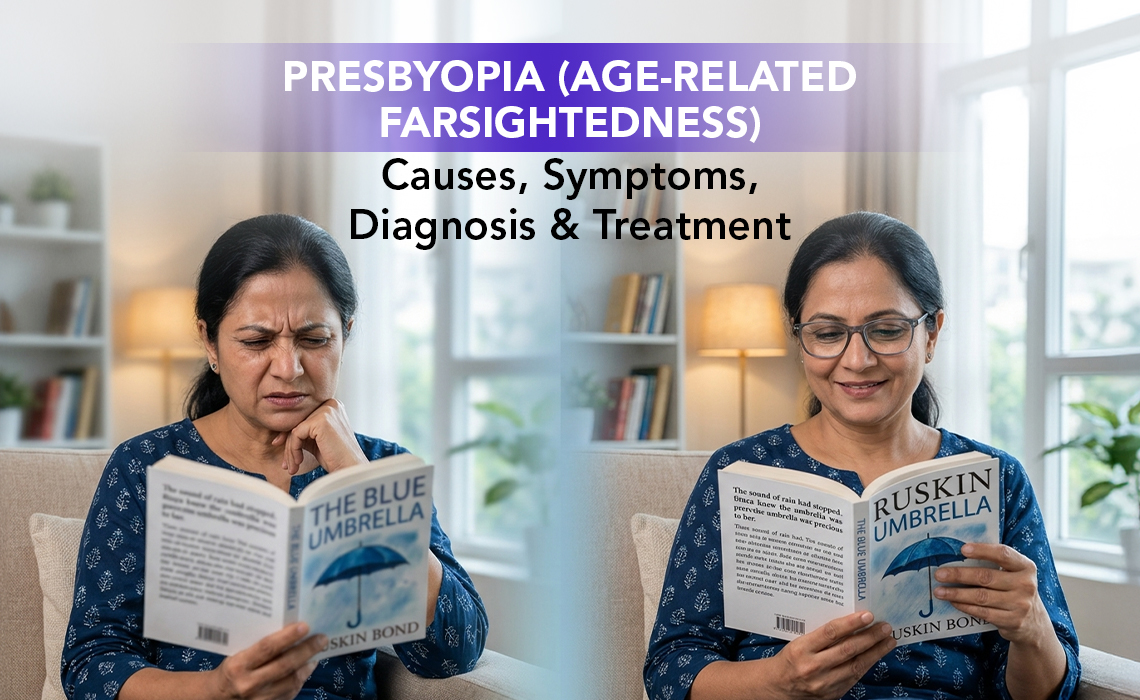
Presbyopia is most commonly seen and begins to develop in the 40s with ageing. Presbyopia, also known as age-related long-sightedness or far-sightedness, is the age-related gradual loss of your eyes’ ability to focus on near objects. Most people first notice this change when, after age 40, they need reading glasses to read books, their smartphones, or small print.
This blog on presbyopia symptoms is a one-stop shop for people with presbyopia, and ways to treat presbyopia and more…
What Is Presbyopia? Complete Guide to Age-Related Long-Sightedness After 40
Presbyopia is a condition in which the eye loses the ability to focus on nearby objects, such as reading material, with age. Unlike the other types of refractive error, caused by a long or short eye shape, presbyopia is an age-related phenomenon arising from natural hardening of the lens with ageing.
In younger people, this lens becomes even more dome-shaped, allowing focus for both near and distant objects. But as we get older, that lens becomes more rigid, and the eye’s muscles are less capable of accommodating. That makes it difficult to read fine print, sew, or use a computer. That’s a normal part of ageing, and it does not mean the eyes are unhealthy. The good news is that there are solutions for treating presbyopia—eyeglasses and contact lenses, as well as surgical options such as presbyopia laser treatment and presbyopic LASIK.
Causes of Presbyopia
It is mainly due to normal age-related changes in the eye. Presbyopia is primarily caused by:
Ageing of the Eye Lens
In older age, the eye’s natural lens moves toward more thickness and less flexibility, making it harder and harder to focus at close distances.
Natural Aging Process
Presbyopia is a normal part of ageing that nearly everyone experiences.
Loss of Lens Elasticity
The lens becomes unable to change shape quickly, which is how we focus on near-field objects.
Weakening of Eye Muscles
These muscles that adjust the lens’s focus can become less elastic as we age.
Common Symptoms of Presbyopia
Presbyopia symptoms generally worsen over time and may cause increasing difficulties.
Difficulty Reading Small Print
Others may struggle to read books, newspapers, or phone screens further than their reach.
Eye Strain
Extended reading or time in front of a screen can tire eyes or cause irritation.
Headaches After Close Work
Frequent headaches can also happen after reading, sewing, or other detailed tasks.
Need for Brighter Light
Many people need brighter lighting to read clearly.
Holding Reading Material Farther Away
One typical symptom of presbyopia is the need to hold your arms outstretched to read more clearly.
Who is at Risk & When It Starts
Presbyopia is also closely associated with ageing, but the timeline will vary a bit from person to person.
Around Age 30
Some people may start to notice very mild focusing difficulties, especially when reading for extended periods.
Age 40 and Above
After 40, most people start having visible symptoms and might need reading glasses.
Age 65
At this age, lens flexibility decreases significantly, and presbyopia usually stabilises.
People with existing vision issues, such as myopia or hyperopia, may notice presbyopia earlier.
Treatment Options for Presbyopia
So the question many have is, how is presbyopia corrected? The good news is that several effective treatments are available.
Reading Glasses
The most common presbyopia treatment and the simplest one you could do is to wear reading glasses. These help refract light independently of the lens to ensure they fall on the retina and also improve your nearsightedness.
Bifocals and Progressive Lenses
These lenses are helpful for people who need correction for both near and distant vision.
Bifocal lenses have two different lens powers.
These designs allow a smooth transition from distance to intermediate and then near vision.
Contact Lenses
Presbyopia can also be corrected with lenses.
Monovision Contact Lenses
One eye is adjusted for distance vision, while the other is for near vision.
Multifocal Contact Lenses
These lenses can correct both near and distance vision at once.
LASIK Surgery for Presbyopia
LASIK eye surgery for presbyopia: Some people opt for LASIK, where the cornea is reshaped to improve focusing.
Laser Eye Treatment for Presbyopia
Advanced laser eye treatment for presbyopia provides relief from near-vision issues and reduces dependence on glasses, but it is applicable to only a few candidates.
Surgical Options
Other types of surgery might involve changing the natural lens (in addition to surgical refraction) or inserting special lenses behind the cornea. So, these procedures are considered typical when everything else cannot be done.
Management & Living with Presbyopia
There is no cure for presbyopia, but proper eye care and lifestyle habits can help manage it.
Daily Vision Care Tips
Also, make sure the lighting is good when reading or performing close-up tasks.
Regular Eye Check-ups
Regular eye exams help identify changes in vision as they occur and provide up-to-date prescriptions if needed.
Conclusion
When we are younger, the muscles in our eyes help us to focus on up-close objects, but this changes with age as your eye needs help focusing. Presbyopia is one of those common age-related changes with our eyes.Follow where presbyopia hits most people around age 40 (though it can be earlier).
Knowing the presbyopia symptoms when appropriate presbyopia treatment is needed and scheduling frequent eye exams can be particularly useful in having a clear, comfortable vision even after 40 years of age. Fortunately, there are options available to manage presbyopia, and the vast majority of individuals can continue living their normal lifestyle thanks to reading glasses, contacts, multifocals (progressive lenses), and even new surgical techniques. While prevention and self-care are crucial, accurate diagnosis and innovative treatment by professionals at a reputable eye care institution, such as Neoretina, can help meet your vision needs.
FAQ’s

- Eye Floaters and Flashes: Causes, When to Worry, and Treatment - July 27, 2026
- Eye Twitching: Why It Happens and When to See a Doctor - July 27, 2026
- Thinking About LASIK? Here’s the Truth About Safety & Results - July 1, 2026